
Most of what I read in a day I do not really read. I scan it, sort it, decide whether it is worth reading, and then usually move on before deciding. By evening I have taken in a great many words and kept almost none of them. It is a kind of reading, but it is closer to sorting the post.
Real reading is slower, and I have had to relearn it. Not because I forgot how, but because the habit of scanning crept into everything, including the books I most wanted to read properly. I would find myself three pages on with no idea what had happened, my eyes having carried on without me.
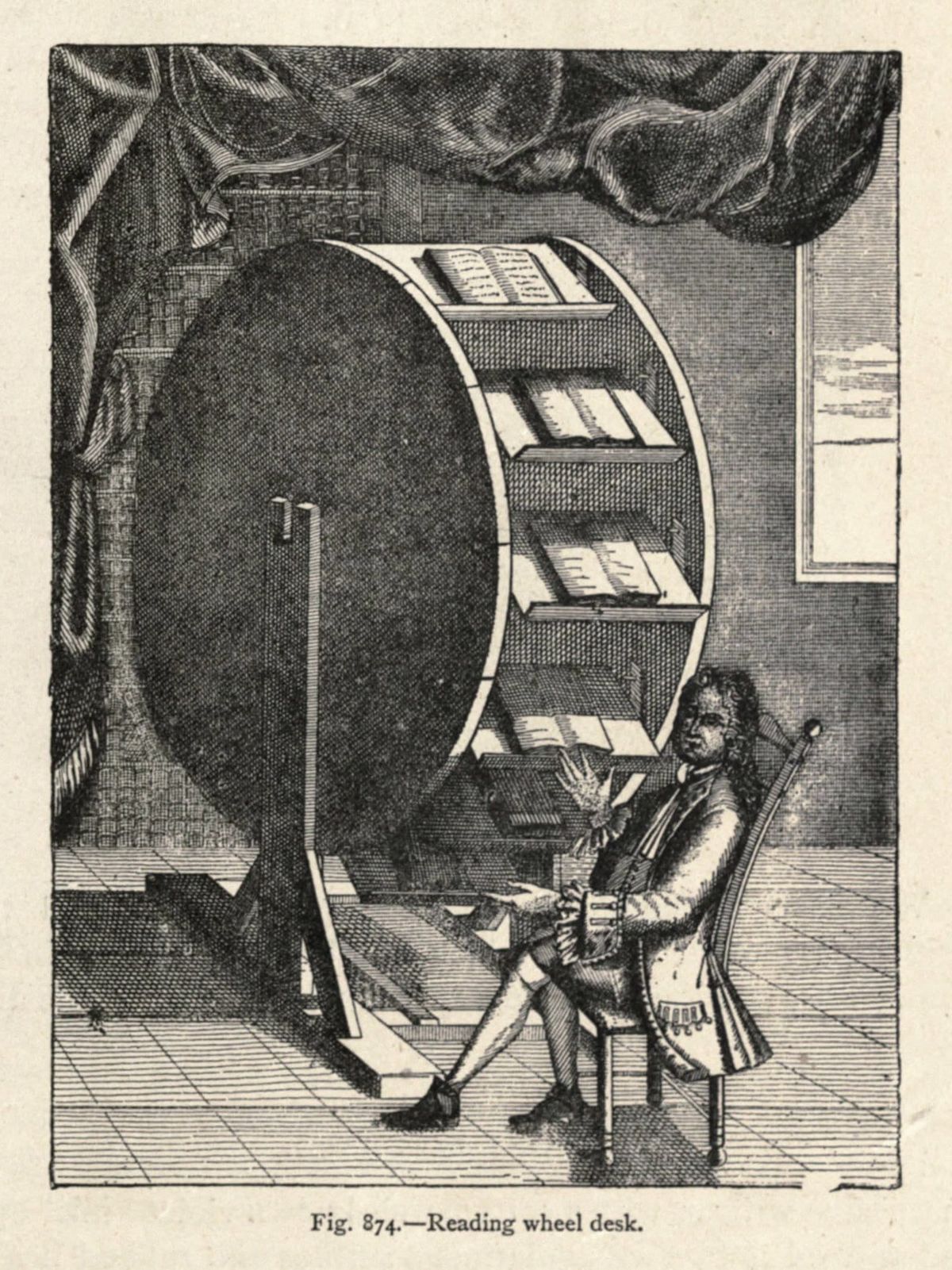
In the sixteenth century an engineer called Agostino Ramelli designed a reading wheel: a great revolving drum of shelves, so that a scholar could keep a dozen books open at once and turn from one to the next without leaving the chair. Versions of it were still being built three hundred years later. It is a beautiful machine, and it is the exact opposite of what I want.
Deliberately and reservedly
Thoreau has a chapter on reading in Walden that I return to more than any other part of the book. His argument is simple and a little stern: that the best books were written slowly, with great care, and so they must be read the same way.
Books must be read as deliberately and reservedly as they were written.
I used to find that a little priggish. Now it seems merely practical. A sentence that took someone an afternoon to get right deserves more than a second of my attention. Not out of respect, though that too, but because otherwise I will miss what it says.
A few habits
None of this is a method, exactly. But a few things have helped:
- Reading on paper, where possible, so that nothing else is one tap away.
- Reading the same book for a whole afternoon, rather than a chapter here and there.
- Reading aloud, quietly, when a passage seems to matter. The ear catches what the eye skips.
- Stopping at the end of a chapter and saying, to nobody, what happened in it.
The last one sounds foolish and is the most useful. If I cannot say what happened, I did not read it. I go back.
What it gives back
I read fewer books now than I did a few years ago. I remember far more of them. And I find, more and more, that the pleasure of reading was never really in the number of books finished but in the hours spent inside them, the long afternoons in which the room fades and there is only the page.
That is worth slowing down for.